Pag-IBIG Housing Loan for OFWs
Understand the OFW income documents, application forms, online submission steps and representative rules that matter when you are working outside the Philippines.
Quick answer
OFWs can apply for a Pag-IBIG housing loan. The main difference is the way overseas income, identity and representative authority are documented. The official online service accepts an employment contract, a Certificate of Employment and Compensation or a host-country income tax return as OFW proof-of-income options.
You can submit the initial package online, but approval is not automatic. Pag-IBIG may still validate originals, assess the property, request additional proof and require a representative for transactions that must be completed in the Philippines.
Can an OFW qualify for a Pag-IBIG housing loan?
Working abroad does not disqualify a Pag-IBIG member. An OFW application is assessed under the housing loan program, with added attention to overseas employment, foreign documents, identity validation and any representative who will act in the Philippines.
Pag-IBIG considers more than nationality, job location or monthly salary. The assessment can include membership and savings records, documented repayment capacity, existing obligations, the requested term, the property value and the legal condition of the property. A high overseas salary does not replace incomplete forms or defective property papers.
Review the full Pag-IBIG housing loan requirements before preparing the OFW-specific records below. That page owns the general applicant and property checklist, while this article focuses on documents and actions created by working overseas.
Pag-IBIG housing loan requirements for OFWs
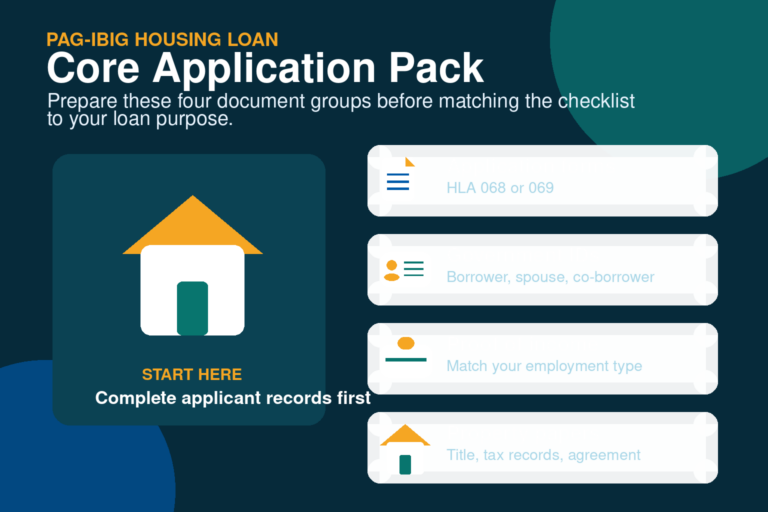
An OFW application contains a general borrower package, an overseas income package and the documents required for the property transaction. Prepare readable files for online submission and keep the originals available.
Applicant documents
- HLF068 for the principal borrower
- HLF069 when there is a co-borrower
- One valid government-issued ID with signature
- A clear selfie holding the same ID for the online service
- Civil-status records when applicable
- Consistent MID, name, birth date and contact details
OFW and property documents
- Accepted proof of overseas income
- English translation for foreign-language records
- Property papers for the selected loan purpose
- SPA and representative documents when needed
- Passport, visa or Seaman’s Book for validation when requested
- Additional evidence requested during assessment
How an OFW can prove income
Pag-IBIG’s official online housing loan service lists three main OFW proof-of-income options. Use a current, readable document that clearly connects you to the employer or income source.
| Official income option | What it should show | Important preparation point |
|---|---|---|
| Employment contract | Employee, employer, compensation, contract period and employment terms | Use the employer contract or the applicable standard overseas employment contract. Submit a complete copy, not selected pages. |
| Certificate of Employment and Compensation | Position, employment status, compensation and employer confirmation | Use official company letterhead when available. Household staff may use an employer-signed certificate supported by the employer’s ID or passport. |
| Host-country income tax return | Declared income filed under the tax system of the country of work | Include the complete record and an English translation when the document is in another language. |

Supporting records that can help with validation
Supporting evidence is not automatically a substitute for the official income options. However, Pag-IBIG may ask for more information when the contract, employer, compensation or continuity of income needs clarification. Prepare supporting records before submission so you can respond without searching for them under a deadline.
- Passport and current working visa or permit
- Recent payslips or payroll records
- Bank or remittance records showing salary transfers
- OWWA, OEC or deployment records when applicable
- Employer contact details that can be verified
- English translation of foreign-language documents
Representative and Special Power of Attorney rules
A representative may become necessary when the property transaction, identity validation, document signing or loan release requires an action in the Philippines. A general authorization letter may not be enough for legal and property-related acts.
When an OFW may need a representative
- Submitting or receiving original property records
- Coordinating appraisal and property inspection
- Signing documents specifically allowed by the SPA
- Completing identity validation or Pag-IBIG follow-up
- Receiving a check or participating in release procedures when permitted
- Coordinating with the seller, developer or government offices
The SPA must describe the powers the representative will use. Do not copy a broad template without checking whether it covers the exact housing loan and property transaction.
| Where the SPA is executed | Typical current Pag-IBIG checklist treatment | What the member should do |
|---|---|---|
| Apostille country | Use an apostilled SPA executed abroad. | Confirm the competent apostille authority and Pag-IBIG’s current original-document requirement before sending it. |
| Non-apostille country | Use Philippine consular authentication, or local notarization followed by the required Philippine consular authentication. | Ask the Philippine embassy or consulate and Pag-IBIG which sequence applies in the host country. |
| Notarized in the Philippines | Current checklists may request passport or Seaman’s Book pages showing the member’s entry and exit dates. | Keep the relevant travel record with the notarized SPA so the place and timing of execution can be validated. |

How to apply for a Pag-IBIG housing loan from abroad
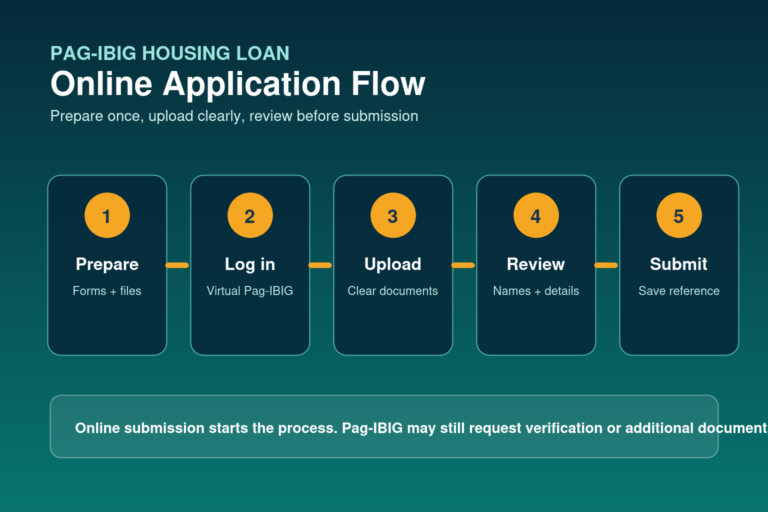
The online service reduces the need to submit the initial package in person. It does not remove property evaluation, document validation or the need to complete later Philippine-based steps.
Check your member record
Confirm your MID, personal details and contribution records. Correct name or birth-date differences before they appear across several loan documents.
Estimate a realistic loan amount
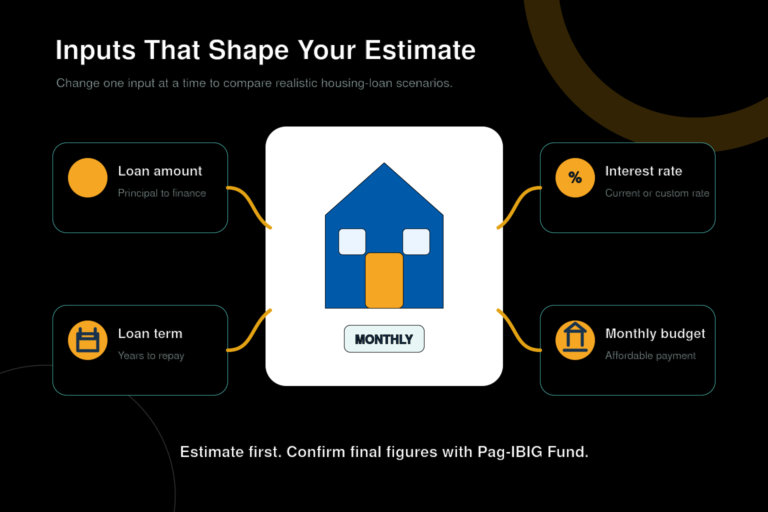
Use documented income and current obligations. Test possible terms with the housing loan calculator and review the current rate explanation.
Prepare the correct application pack
Complete HLF068, HLF069 when applicable, OFW proof of income, one valid ID, the required selfie and the property records available at the application stage.
Submit through the official online service
Log in to Virtual Pag-IBIG and use the housing loan application service. The full screen-by-screen process is covered in the online application steps.
Respond to validation requests
Monitor the email address and mobile number entered in the application. Provide clarifications, readable replacements or additional evidence through the official channel identified by Pag-IBIG.
Coordinate Philippine follow-up
Prepare the property owner, developer or authorized representative for inspection, original-document submission, signing and release requirements.

Applying through a developer versus applying as an individual
Developer-assisted purchase
An accredited developer may coordinate the property and project documents and may have a separate developer submission process. The OFW still needs to complete the personal, identity and income records accurately.
Ask which documents are submitted by the developer, which must come directly from you, and which original documents will be required later.
Individual application
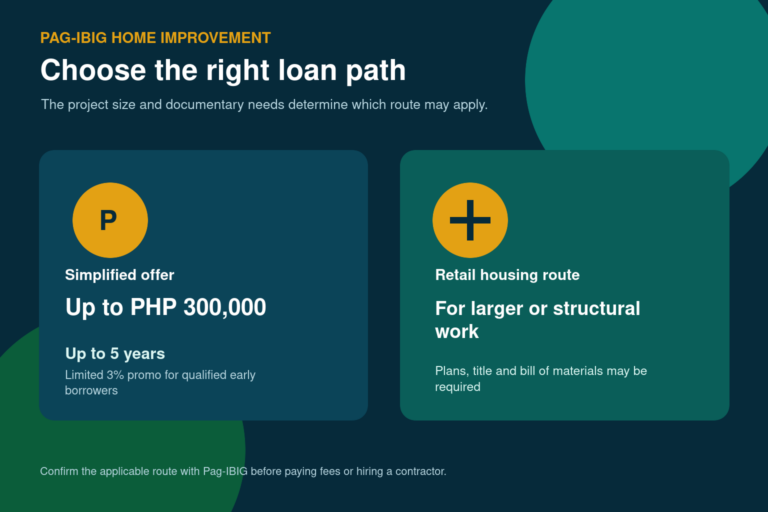
For a private purchase, construction, improvement or refinancing transaction, the borrower usually coordinates more directly with the seller, property owner, engineer or representative. Property-document requirements depend on the loan purpose.
Do not send money to a seller based only on a calculator estimate or an online submission acknowledgement.
Seafarers, spouses, co-borrowers and former OFWs
Seafarers
A seafarer can apply using current employment and income records. Keep the complete employment contract, Seaman’s Book, passport, compensation proof and deployment information available. Contract gaps or changing vessels do not automatically cause rejection, but they may require a clearer explanation of income continuity.
Spouse or co-borrower
A spouse can be included as a co-borrower when the application structure supports it. Prepare separate income evidence and valid identification, and make sure the civil-status records and names are consistent. Acting as a representative is a different role and may require an SPA.
Former or returning OFW
An expired overseas contract may not prove current repayment capacity. Use present employment, business, pension, remittance or other verifiable income documents. Explain the transition from overseas work instead of presenting old income as if it were still active.
Country-specific searches
OFWs in the UAE, Qatar, Saudi Arabia, Taiwan, Japan, Singapore, Hong Kong and other locations generally use the same housing loan program. The country mainly changes the document language, income format and apostille or consular authentication process.
How much can an OFW borrow?
There is no single loan amount assigned to all OFWs. Pag-IBIG evaluates the amount using documented repayment capacity, the appraised property value, the purpose of the loan, the term, existing debts and the program rules applicable to the application.
Use net income that can be supported by the documents you will submit. Convert foreign-currency income carefully and allow room for exchange-rate movement, family expenses, insurance, fees and other debts. A comfortable payment plan is more useful than testing only the maximum possible amount.
The Pag-IBIG housing loan calculator helps compare monthly payment scenarios. The interest-rate article explains fixed pricing periods and repricing, which matter when the loan continues long after an OFW contract ends.
Common OFW application problems and how to correct them
| Problem | Why it causes delay | Practical correction |
|---|---|---|
| Employer or salary details do not match | Pag-IBIG cannot confidently connect the contract, certificate and payment records. | Ask the employer for a corrected record or attach a clear explanation supported by official evidence. |
| Foreign-language document has no translation | The reviewer cannot validate key terms and compensation details. | Provide the original and a complete English translation. |
| SPA uses the wrong authentication route | The representative’s authority may not be accepted for the intended act. | Confirm whether apostille or Philippine consular authentication applies before signing. |
| Representative has incomplete identification | Identity validation or release procedures cannot be completed. | Prepare the IDs and any Authority to Inspect or Verify Account Information required for the transaction. |
| Files are cropped, blurred or too large | Important signatures, dates or document edges cannot be reviewed. | Rescan the complete page, keep text readable and follow the current file-size instructions. |
| Property seller cannot provide complete records | Income qualification cannot cure a property-title or documentation problem. | Resolve the property issue before making non-refundable payments. |
Security advice for OFWs applying from abroad
- Use only official Pag-IBIG and Virtual Pag-IBIG pages.
- Do not share login codes or passwords with a representative.
- Send identity and income files only through an authorized channel.
- Verify the identity of agents, sellers and developers independently.
- Read the SPA carefully before signing or authenticating it.
- Keep copies of every uploaded and original document.
- Do not pay a fee to anyone promising guaranteed approval.
- Confirm account-specific instructions directly with Pag-IBIG.
An authorized representative may handle defined transactions, but that does not require access to your Virtual Pag-IBIG password, email account or one-time PIN. Keep control of your account and give only the legal authority needed for the named transaction.
Official resources
Official online application reminder
Review the current form, identification, selfie and OFW proof-of-income instructions before uploading files.
Pag-IBIG Fund
Use the official website and member channels for the latest forms, overseas-service information and account-specific confirmation.
Related Pag-IBIG housing loan information
Frequently asked questions
Can an OFW apply for a Pag-IBIG housing loan?
Yes. An overseas Filipino worker may apply for a Pag-IBIG housing loan if the member meets the current eligibility rules and can document sufficient income. Pag-IBIG will also evaluate the requested loan amount, existing obligations, property documents and the proposed repayment term.
What are the Pag-IBIG housing loan requirements for OFWs?
An OFW generally prepares the correct housing loan application form, valid identification, proof of overseas income and the property documents required for the loan purpose. If another person will act in the Philippines, Pag-IBIG may also require a properly executed Special Power of Attorney and representative documents.
Which application form should an OFW use?
The principal borrower uses the Housing Loan Application form identified by Pag-IBIG as HLF068. A co-borrower uses HLF069. Download or complete the current version provided through the official housing loan service rather than reusing an old saved copy.
What proof of income can an OFW submit?
The official online housing loan service lists an employment contract, a Certificate of Employment and Compensation, or a host-country income tax return as OFW proof-of-income options. Pag-IBIG may request additional records when it needs to validate the applicant’s income or employment.
Is an overseas employment contract enough?
An employment contract is one of the official proof-of-income options, but it does not guarantee approval by itself. The contract should clearly identify the employee, employer, compensation and contract terms, and Pag-IBIG may ask for supporting records or clarification.
Can a household service worker use a Certificate of Employment and Compensation?
Yes. The official OFW proof list allows a Certificate of Employment and Compensation signed by the employer for household staff, supported by a photocopy of the employer’s ID or passport. The document should be readable and consistent with the applicant’s other records.
Do foreign-language documents need an English translation?
Yes. The official online application reminder states that documents written in a foreign language must include an English translation. Prepare a clear translation and keep the original document available for validation.
Can an OFW apply for a housing loan online from abroad?
Yes. The member can use the official Virtual Pag-IBIG housing loan application service to submit the initial application package online. Pag-IBIG may still request original documents, identity validation, property records or follow-up actions in the Philippines.
Does an OFW need a representative in the Philippines?
Not every initial online submission requires a representative, but one may be necessary for property transactions, document signing, identity validation, check release or other actions that cannot be completed by the member abroad. Confirm the exact scope before preparing an SPA.
What is the SPA requirement for an OFW housing loan?
The Special Power of Attorney must clearly authorize the representative to perform the required housing loan and property-related acts. The authentication path depends on where it is executed and whether the country participates in the Apostille Convention.
What if the OFW is in an apostille country?
Current Pag-IBIG housing loan checklists indicate that an SPA executed in an apostille country should be apostilled. The member should confirm the current process with the competent authority in the host country and Pag-IBIG before sending the original.
What if the OFW is in a non-apostille country?
Current checklists indicate that an SPA executed in a non-apostille country should be authenticated by a Philippine consular officer, or locally notarized and then authenticated through the Philippine consular process. Requirements can vary by country, so confirm the current instructions before signing.
Can an OFW’s spouse apply or act as representative?
A spouse may be a co-borrower or representative when the application structure and documents support that role. Marriage records, identification, income proof and a valid SPA may be required depending on what the spouse will do.
Can a seafarer apply for a Pag-IBIG housing loan?
Yes. A seafarer can apply subject to the same eligibility and credit assessment. The official OFW income list recognizes an employment contract, including the standard overseas employment contract where applicable, and Pag-IBIG also recognizes a Seaman’s Book among acceptable identification records in the online reminder.
Can a former OFW apply after returning to the Philippines?
Yes, but the applicant should use current and verifiable income evidence. If the overseas contract has ended, Pag-IBIG may assess the applicant using present local employment, business income, pension, remittances or another documented source rather than relying only on an expired contract.
Is there a different Pag-IBIG housing loan for OFWs in Dubai, Qatar, Japan or another country?
The housing loan program is not normally a separate product for each host country. The main differences involve income documents, translation, identity validation and the authentication or apostille process for documents executed abroad.
How much can an OFW borrow from Pag-IBIG?
The approved amount depends on documented repayment capacity, the property value, the requested purpose, the chosen term and Pag-IBIG’s assessment. Use the housing loan calculator for planning, but treat the result as an estimate rather than an approval.
Where should an OFW ask for account-specific housing loan help?
Use the official Virtual Pag-IBIG service or Pag-IBIG Fund’s official contact and overseas-service channels. Account-specific questions, document validation and country-specific authentication instructions should be confirmed directly with Pag-IBIG.
Independent information notice
This website is an independent informational resource and is not Pag-IBIG Fund or a Philippine government website. Housing loan requirements, forms, overseas document procedures and property conditions can change. Confirm the latest instructions with Pag-IBIG Fund before submitting originals, authenticating an SPA, paying a seller or authorizing a representative.