Pag-IBIG Late Payment Penalty for Employers
Learn the contribution penalty rate, estimate the amount by days late, check the employer remittance deadline, and correct a missed payment without creating duplicate schedules.
Quick answer
A private or public employer that fails to remit required Pag-IBIG contributions on time can be charged a late-payment penalty. Republic Act No. 9679 states a penalty of 3% per month on the unpaid amount from the date it becomes due until paid. Pag-IBIG remittance instructions commonly express the working computation as 0.1% of the amount due per day of delay.
A practical estimate is amount due × 0.001 × days late. The final amount should still be confirmed through Pag-IBIG because the official assessment controls the exact deadline, delay period, adjustments, and account history.
Which late payment does this article cover?
This page is about an employer that remits employee Monthly Savings and the employer counterpart after the applicable deadline. It also covers the practical steps used to correct an unpaid or delayed contribution schedule.
The keyword file also contains searches for housing-loan, salary-loan, multi-purpose-loan, calamity-loan, and voluntary-member penalties. Those are different intents. Their rates and consequences depend on the applicable loan agreement or member category and should not be combined with the employer contribution formula.
Pag-IBIG late payment penalty rate
The law and remittance instructions describe the same employer liability in two useful ways. Employers should understand both, then rely on the official Pag-IBIG assessment for settlement.
3% per month under RA 9679
Section 23 of the Home Development Mutual Fund Law of 2009 states that nonpayment subjects the employer to a penalty of 3% per month of the amount payable from the date the contributions fall due until paid.
0.1% for each day of delay
Pag-IBIG remittance-form instructions commonly state a penalty equivalent to one-tenth of one percent of the amount due per day of delay, beginning after the due date and continuing until full settlement.
How to compute the Pag-IBIG penalty for late payment
Use this formula for an initial employer estimate. Enter the total delayed contribution amount and the number of days recognized as late.

This calculator is informational. It does not determine the official deadline, days of delay, approved adjustment, condonation, or final amount posted to the employer account.
Sample computations
| Amount due | Days late | Estimated penalty | Estimated total |
|---|---|---|---|
| ₱4,000 | 5 days | ₱4,000 × 0.001 × 5 = ₱20 | ₱4,020 |
| ₱10,000 | 12 days | ₱10,000 × 0.001 × 12 = ₱120 | ₱10,120 |
| ₱50,000 | 30 days | ₱50,000 × 0.001 × 30 = ₱1,500 | ₱51,500 |
Employer contribution remittance deadlines
Pag-IBIG remittance instructions use a staggered schedule based on the first letter of the registered employer or business name. The payment applies to the contribution period from the preceding month.
| First letter of registered employer name | Standard remittance window | Practical action |
|---|---|---|
| A to D | 10th to 14th | Complete the schedule and payment before the last day of the window. |
| E to L | 15th to 19th | Do not assume every employer follows a fixed 15th deadline. |
| M to Q | 20th to 24th | Use the registered name, not an informal trade abbreviation. |
| R to Z or numeral | 25th to the end of the month | Confirm the last allowed day when a holiday or system notice affects processing. |

How to count the days late correctly
Identify the real deadline
Use the registered employer name, applicable contribution month, and the current Pag-IBIG remittance instruction. Do not count from an assumed date.
Start after the deadline
The delay begins on the first day immediately following the due date recognized for the account.
Stop at full settlement
The delay continues until the contribution obligation and applicable assessment are fully settled, subject to Pag-IBIG’s official computation.
What to do after missing the Pag-IBIG deadline
Confirm the affected contribution period
Identify the exact month, employees, employee shares, employer counterparts, and any amount already paid.
Check the original schedule and payment status
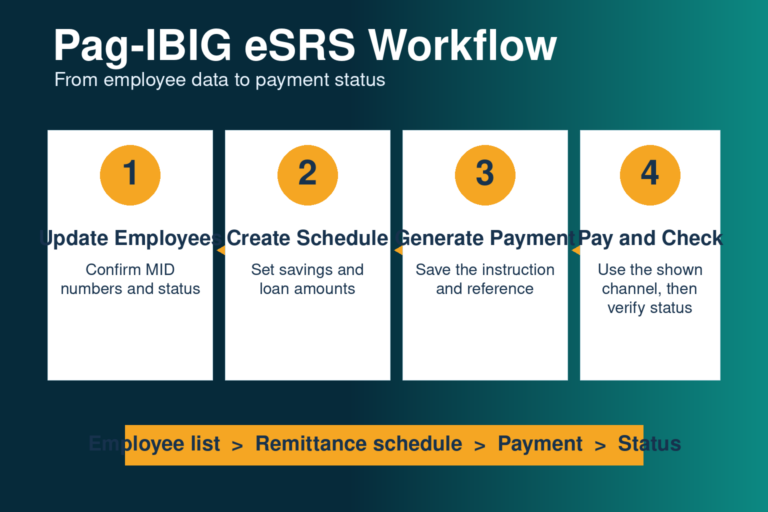
Review eSRS, payment instructions, bank or collecting-partner records, and any reference number before generating another schedule.
Request or calculate the penalty assessment
Use the daily formula as an estimate, but obtain the amount recognized by Pag-IBIG when the account, branch, or system provides it.
Correct the employee remittance schedule
Make sure employee names, MID Numbers, coverage month, and contribution amounts match the payroll records.
Pay through an official channel
Follow the payment instruction connected to the verified schedule. Do not send money to an individual or unverified account.
Keep proof and verify posting
Save the schedule, assessment, payment reference, official receipt, and later posting confirmation for payroll and audit records.

How eSRS helps with late remittance
The Pag-IBIG eSRS is used by eligible employers to prepare and submit employee remittance schedules and obtain payment instructions. It can help identify the coverage period, employee records, amounts, and status connected to the employer’s transaction.
When a schedule or payment fails, do not repeatedly click submit or create a second schedule without checking the first reference. A duplicate schedule or duplicate payment can make reconciliation harder than the original late remittance.
Who pays the penalty?
The employer is responsible for setting aside and remitting both the required employee savings deducted through payroll and the employer counterpart. A penalty caused by the employer’s late remittance is an employer liability and should not be shifted to employees through an unauthorized deduction.
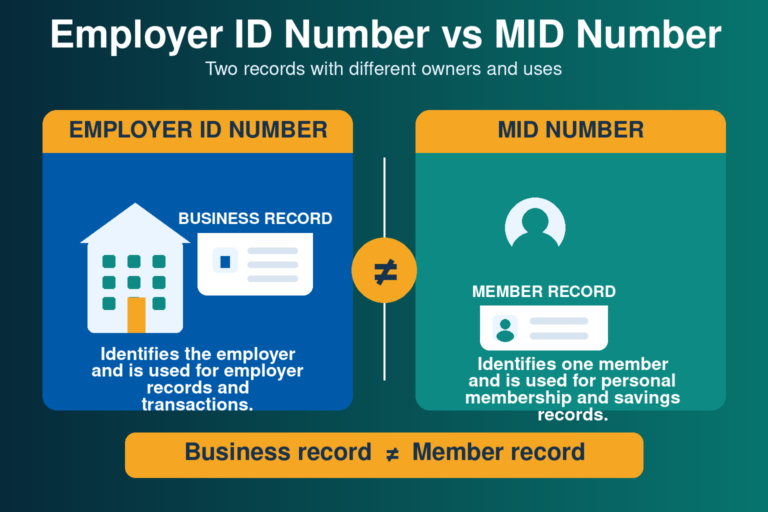
The employee’s own share may already have been deducted from salary. Keep payslips and payroll records because they show whether the deduction occurred and which period it covered. The Employer ID Number and each employee’s correct MID Number also help Pag-IBIG locate the affected records.
Can penalties be condoned?
The Pag-IBIG Board has authority under Republic Act No. 9679 to condone employer penalties for justifiable reasons under approved terms and conditions. Pag-IBIG has also issued time-limited condonation programs in the past.
Condonation is not automatic. An employer should not rely on a historical circular, old news article, or expired application period. Ask Pag-IBIG whether a current program applies, what arrears must be paid, whether an installment plan is permitted, and what happens if the employer defaults on an approved settlement.
Late contribution penalty versus loan penalty
| Late obligation | Who owes it | Use this article? |
|---|---|---|
| Employee and employer Monthly Savings remittance | Employer | Yes. This is the primary intent of this page. |
| Housing-loan amortization | Member-borrower, subject to the housing agreement | No. Housing-loan penalties and restructuring are separate. |
| Multi-purpose or calamity-loan installment | Member-borrower, with separate rules | No. Review the applicable short-term-loan terms. |
| Salary-deducted loan amortization not remitted by employer | May create an employer remittance issue under the loan rules | Not with the contribution formula. Ask Pag-IBIG for the loan-specific assessment. |
| Voluntary member payment | Individual member | No. The employer penalty in RA 9679 is not the same situation. |
How employers can avoid another penalty
- Maintain a monthly remittance calendar
- Use the registered employer name for the due window
- Reconcile payroll before submitting the schedule
- Verify every employee MID Number
- Submit before the final allowed day
- Keep a backup payment approver
- Save eSRS and payment references
- Review posting after payment
- Update separated and newly hired employees
- Escalate failed transactions before repeating them
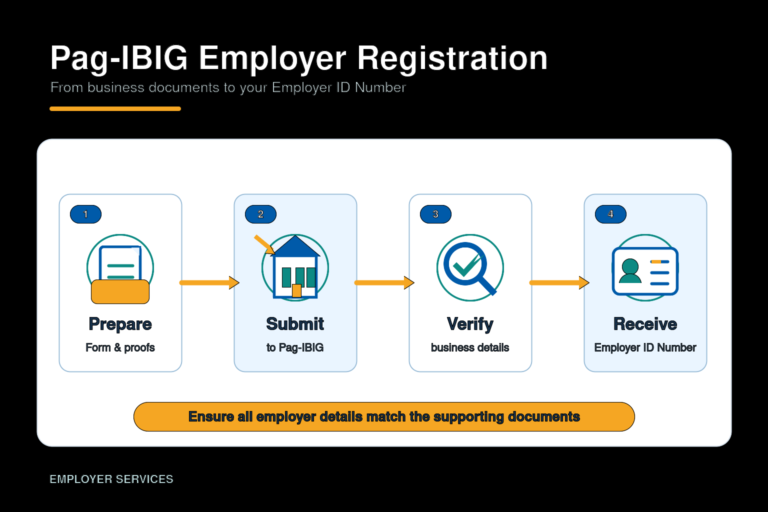
New establishments should first complete Pag-IBIG employer registration and secure the correct employer record. Employers should also keep the contribution rates and salary cap aligned with the current Pag-IBIG contribution table.
Frequently asked questions
How much is the Pag-IBIG penalty for late employer contributions?
Republic Act No. 9679 states a penalty of 3% per month on unpaid employer remittances. Pag-IBIG remittance instructions commonly express the operational computation as 0.1% of the amount due for each day of delay, beginning after the applicable deadline and continuing until full settlement.
What formula can an employer use to estimate the penalty?
A practical estimate is amount due multiplied by 0.001 multiplied by the number of days late. The official assessment from Pag-IBIG controls when the portal or servicing branch calculates a different amount because of the exact deadline, payment date, adjustment, or account history.
When does the penalty start?
The penalty normally begins on the first day immediately following the applicable remittance deadline. Confirm the deadline assigned to the registered employer name and the coverage month before counting the delay.
Are weekends and holidays counted?
The employer should use the delay period recognized by Pag-IBIG for the account. Do not guess when a deadline falls on a weekend or holiday. Confirm the due date and assessed days through eSRS, the payment instruction, or the servicing branch.
What amount is used in the penalty computation?
Use the employer contribution obligation that remained unpaid for the affected period, including the required employee and employer shares included in the delayed remittance. Do not mix unrelated housing-loan or member-loan balances into this contribution calculation.
Can the employer deduct the penalty from employees?
The employer is responsible for late-remittance penalties arising from its failure to remit on time. The employer counterpart and employer penalty should not be shifted to employees through an unauthorized payroll deduction.
Does a late remittance remove the employee's Pag-IBIG benefits?
Republic Act No. 9679 states that the employer's failure or refusal to remit does not prejudice the covered employee's right to benefits. The employer remains liable for the unpaid contribution, penalty, and any other applicable consequences.
What should an employer do after discovering a missed deadline?
Confirm the coverage month, amount due, assigned deadline, employee list, and existing payment references. Then use eSRS or the servicing Pag-IBIG branch to obtain the correct assessment, pay through an official channel, and preserve the receipt and schedule.
Should I create another eSRS schedule after a failed payment?
Not automatically. First check whether the original schedule, payment instruction, or transaction is still valid or already posted. Creating duplicates can lead to a repeated schedule or double payment.
Is the late penalty the same for housing loans?
No. Housing-loan penalties are governed by the housing-loan agreement and current housing-loan rules. This article covers employer penalties for late contribution remittance only.
Is the penalty the same for Pag-IBIG multi-purpose or calamity loans?
No. Member short-term loans have their own penalty and default rules. A separate employer issue may also arise when salary-deducted loan amortizations are not remitted, but that is different from late mandatory-savings contributions.
Does a voluntary member pay the same employer penalty?
The 3% monthly employer liability in Republic Act No. 9679 applies to employers required to set aside and remit contributions. A voluntary member paying personally is not the employer-remittance situation covered by this page.
Can Pag-IBIG waive or condone the penalty?
The law allows the Pag-IBIG Board to condone employer penalties for justifiable reasons under approved terms. Condonation is not automatic, and an old or expired program cannot be assumed to remain open. Ask Pag-IBIG whether a current program applies.
How can an employer prevent future penalties?
Maintain a monthly payroll and remittance calendar, verify the registered employer name and due window, reconcile employee records before submission, use eSRS correctly, pay before the last allowed day, and keep proof of every schedule and payment.
Where should an employer ask for the final penalty amount?
Use the official Pag-IBIG employer service, eSRS, the servicing branch, or an official Pag-IBIG contact channel. The website calculator on this page is an estimate and does not replace the official account assessment.
Related employer information
Official references
Home Development Mutual Fund Law
Section 23 of Republic Act No. 9679 covers employer remittance liability and the 3% monthly penalty.
Official Pag-IBIG services
Use official Pag-IBIG employer services or the servicing branch for the final account assessment and payment instructions.
Independent information notice
This website is an independent informational resource and is not operated by, affiliated with, or endorsed by Pag-IBIG Fund or any Philippine government agency. Penalty assessments, deadlines, condonation programs, payment references, and account corrections can change or depend on employer-specific records. Confirm the final amount and settlement process through official Pag-IBIG channels.